|
有限会社テクノ・ロジック |
 |
|
お問い合わせEmailアドレス |
|
|
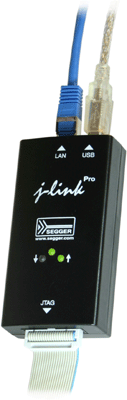
J-Link ARM Pro is a refined version of the regular J-Link. It has an Ethernet interface in addition to the USB interface, as well as two additional LEDs which are used as hardware status indicators. It connects via Ethernet or USB to the Windows (2000/XP/Vista) PC host. J-Link ARM Pro is fully compatible with J-Link ARM and can be used "out-of-the-box". J-Link ARM Pro uses DHCP per default. The built-in webserver makes manual configuration easy and convenient. Ethernet allows using the emulator far away from the PC in a development or production environment; download and debugging speed is higher and Ethernet provides electrical isolation from the PC.
Google Cr-48 Vs Wyvern Moblab InstantMobLab ("Mobile Laboratory") allows manufacturers to run Chrome OS test suites窶敗pecifically Autotest or TAST窶背ithout needing a massive, permanent server room. This public link is valid for 7 days and shares a thread, including any personal information you added. This link or copies made by others cannot be deleted. If you share with third parties, their policies apply. Can窶冲 copy the link right now. Try again later. The Google CR-48 and Wyvern MobLab cater to different needs and preferences. If you're invested in the Chrome OS ecosystem and prefer a traditional netbook experience, the CR-48 might still be a viable option (although it's no longer widely available). However, if you're looking for a highly portable, compatible, and affordable mobile lab solution, the Wyvern MobLab is an excellent choice. Comparing the and Wyvern MobLab highlights two different eras of Google's vision for computing. While the Cr-48 was a revolutionary consumer prototype, the Wyvern MobLab serves as a specialized modern tool for professional testing. Google Cr-48: The Historical Pioneer google cr-48 vs wyvern moblab But in the pantheon of weird, wonderful, and woefully unsupported hardware, they share a soul: both were ahead of their time . The CR-48 predicted the cloud-native, always-connected, low-admin world of 2020s ChromeOS. The Moblabs predicted the modular, ARM-based, FOSS-friendly field computers that we窶决e only now seeing with Framework and Pine64. The software was the entire point of the device. It was a that would become Chrome OS. It forced users to live in the cloud: to a "Wyvern MobLab," a comparison can be framed by looking at the Cr-48 as a historical prototype versus the modern testing environment used in the Chrome OS ecosystem. Overview of Comparison Points If you share with third parties, their policies apply Using the CR-48 in 2011 was a zen exercise. You turned it on. In 8 seconds, you saw a login screen. You typed your Google password. Then窶ヲ a blank browser tab. That窶冱 it. No file system (visible to you), no installers, no viruses. The Cr-48 was revolutionary for having built-in 3G in 2010. The MobLab prioritizes robust Ethernet connectivity to control the devices it is testing. Conclusion ) that manages multiple "DUTS" (Devices Under Test) to perform continuous integration. Comparison at a Glance Google Cr-48 Wyvern MobLab Consumer Prototype / Pilot Internal Testing / Development Early Cloud (2010) Modern ChromeOS (Current) Availability Public Pilot Program Google Internal/Partner Lab User Experience Intentional browser-only laptop Automated test environment The Google CR-48 and Wyvern MobLab cater to Help you understand if a specific Chromebook is eligible for Chrome OS Flex. Compare modern Chromeboxes for home/office use. Let me know which area you'd like to explore further. Laptop Mag Google Cr-48 Chrome Netbook Full Review | Laptop Mag It featured a minimalist, matte-black "unbranded" chassis with no logos. Key Specs: |

 ツ
SEGGER社製
ツ
SEGGER社製